

The Complete
Service Dog Handler Guide
Practical handbook for service dog handlers and disabled handlers — what the ADA requires, what businesses can ask, your rights under the FHA and ACAA, training methods, state-by-state law variations, and what to say when challenged.
In This Guide
Service Dogs vs ESAs vs Therapy Animals — The Differences That Matter
Three categories, three different legal standings. Service dogs (also called working animals or assistance dogs) are individually trained to perform specific tasks tied to a person’s disability. Emotional support animals provide comfort but aren’t task-trained — protected for housing under the FHA, no ADA public access. Therapy animals visit hospitals and schools to comfort other people, not their handler — no federal disability protections, but valued work.
The ADA recognizes only service dogs as service animals (with a narrow miniature-horse provision). Registration with a private registry doesn’t substitute for training or documentation in any category. The federal definition is what matters at the host stand or leasing office.
| Right | Service Dog | PSD | ESA | Therapy Dog |
|---|---|---|---|---|
| ADA public access | Full | Full | None | Invited only |
| FHA housing rights | Yes | Yes | Yes | No |
| ACAA cabin travel | Yes (DOT form) | Yes (DOT form) | No (2021 rule) | No |
| Trained for a task? | Yes | Yes | No — comfort only | No — visits people |
How to Qualify for an Emotional Support Animal
To qualify for an ESA protected by the Fair Housing Act, you need a documented mental or emotional disability, a letter from a licensed mental health professional confirming the animal helps mitigate symptoms, and an animal whose presence — whose mere presence, often — alleviates symptoms during an anxiety attack or panic attacks. ESAs aren’t limited to dogs and cats; birds, rabbits, and small mammals can qualify too.
USAR registers ESAs for documentation but doesn’t issue letters — that requires a licensed clinician. ESAs have FHA housing rights but no public access rights like service dogs.
Service Dog Training Requirements
A service dog must be individually trained to perform tasks directly related to its handler’s disability. There’s no federal curriculum, but training methods generally cover three pillars:
Basic obedience.The dog must be reliably under control in public — calm, focused, non-disruptive across all training sessions in busy environments.
Task training.Specific repeatable tasks that mitigate the disability — retrieving dropped items, alerting to sounds, providing deep pressure or balance support, guiding through public spaces. Working dogs need real task training, not generic obedience.
Public behavior.Calm, focused, non-disruptive in restaurants, transit, stores, and other crowded spaces.
Important: Professional training or certification is NOT required by law. The ADA permits owner-training. A professional training program is one path; many handlers train with help from a private dog trainer or service dog trainer. Either way, fully trained service dogs need to meet behavior and reliability standards. No doctor’s prescription is required for training.
What Tasks Service Dogs Perform for Different Disabilities
Service dogs assist people with disabilities across many conditions. Tasks must be tied to a specific disability — a working dog’s mere presence isn’t a task under the ADA.
Mobility impairments.Physical support and balance support, retrieving dropped items, opening doors, turning on lights, carrying small loads. Wheelchair-using handlers often pair with larger working dogs for steady balance.
Autism.Interrupting repetitive behaviors, providing tactile grounding, guiding through crowded spaces.
PTSD and anxiety (Psychiatric Service Dogs).Reminding handlers to take medication, interrupting self-harming or panic attacks, providing deep pressure therapy during an anxiety attack, guiding to a safe space during episodes. Service dogs trained for post traumatic stress disorder are common with veterans.
Hearing or vision impairments.Alerting to sounds (alarms, doorbells, names) for hearing-impaired handlers; guide dogs for vision-impaired handlers navigate environments and obstacles.
Medical alert.Detecting blood-sugar drops, alerting to seizures or migraines, retrieving medication.
Public Access Rights — Where Service Dogs Are Allowed
Service dogs have full ADA public access rights — restaurants, stores, hotels, public transit, and most places open to the general public. You and your service dog can accompany each other anywhere members of the public are allowed.
If staff approach with questions, only the two-question rule applies:
- Is the dog a service animal required because of a disability?
- What work or task has the dog been trained to perform?
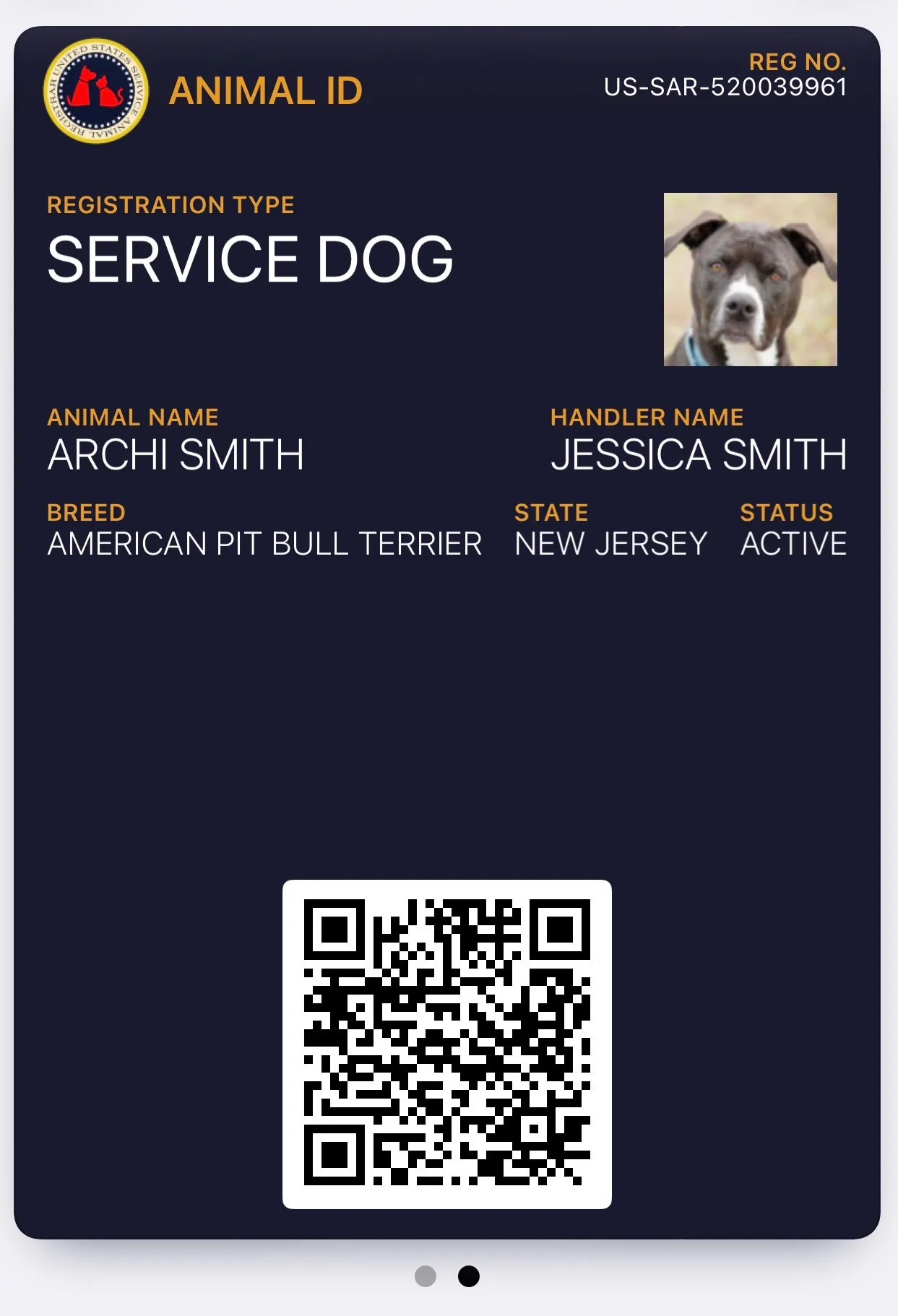
You don’t need to share your specific disability, show medical documentation, or have your dog demonstrate a task. Service dogs aren’t required to wear vests or carry an ID — though a USAR ID card and Apple/Google Wallet pass make these interactions smoother for everyone.
Federal Laws — ADA, FHA, ACAA Explained
Three federal laws protect handlers and working animals.
Americans with Disabilities Act (ADA).Covers public accommodations: restaurants, stores, hotels, transit, government offices. Defines service animals as dogs trained to perform tasks tied to a disability. Staff may ask only two questions; documentation is not required.
Fair Housing Act (FHA).Landlords must accommodate service dogs AND emotional support animals as assistance animals. No pet rent, no pet deposits, no breed or weight limits. ESA letters from licensed clinicians satisfy FHA documentation requests.
Air Carrier Access Act (ACAA).Trained service dogs (including PSDs) fly in cabin under the ACAA. The 2021 DOT rule update removed ESAs. The DOT Service Animal Air Transportation Form is required 48 hours pre-departure.
State and local laws layer additional protections. About 30 states extend the federal floor for working animals.
State-by-State Laws and Regulations
Stay informed about state-specific service dog laws. The ADA is the federal floor; many states add protections for handlers and working dogs:
California — Civil Code §54.1 + §54.2. Misrepresentation is a misdemeanor.
Florida — Stat. §413.08. Misrepresentation is a 2nd-degree misdemeanor.
Texas — Penal Code §121.002. Civil penalties up to $300 for handler interference.
New York — Civil Rights Law §47. Stronger housing protections than federal FHA.
Illinois — White Cane Law (775 ILCS 30/). Penalties up to $500.
Washington — RCW 49.60. Misdemeanor + fines up to $500 for misrepresentation.
About 20 states have specific service-animal misrepresentation statutes. Pick your state in the grid below.
Find your state’s Service Dog guide
All 50 states + DC. Local laws, misrepresentation penalties, state-level protections.
Air Travel With a Service Dog
Air travel requires planning. Most major airlines (Delta, American, United, Southwest, JetBlue, Alaska) allow service dogs in cabin under the ACAA but require completed forms. The DOT Service Animal Air Transportation Form is standard — submit 48 hours before departure. Confirm cabin behavior standards: your dog must fit at your feet, remain calm during turbulence, and respond to handler commands in busy environments.
Day-of tips.Arrive 90 minutes early for separate security screening. Bring water, food, and a relief plan for layovers. The USAR wallet pass is auto-updating and lock-screen ready, so airline staff scan the QR and confirm registration in seconds. See full airline guide.
Hotels and Lodging With a Service Dog
Major hotel chains — Marriott, Hilton, La Quinta, Best Western, Hyatt — accommodate guests with service animals. Use BringFido, Booking.com, or Expedia’s pet-friendly filters; call ahead even when listed dog-friendly. Ask about pet fees, weight restrictions, or required forms.
Under the ADA, US hotels generally cannot charge pet fees for service dogs regardless of pet policy. You’re not required to show documentation — staff may only ask if it’s a service animal and what tasks it performs. Service dogs must remain under handler control and cannot pose a threat or cause significant property damage. ESAs do not have hotel access rights — check policies separately.
Theme Parks and Public Venues
Theme parks like Disney, Universal, and SeaWorld accommodate service dogs. Federal law doesn’t require carrying documentation, but parks may ask the two ADA-allowed questions. A harness, ID tag, or wallet pass makes the process seamless for parks and the general public.
Your service dog must remain calm, under control, and non-aggressive at all times. Leashes or harnesses are typically required. Disruptive behavior (barking, lunging, property damage) can be grounds for removal. Walt Disney World, SeaWorld, and other large venues provide designated relief areas. Some rides may not permit service dogs for safety reasons; staff offer alternative waiting and “rider switch” options.
International Travel With a Service Dog
Overseas travel with your service dog requires country-specific preparation. Australia and New Zealand require mandatory quarantine for incoming animals, even service dogs. EU countries may waive or shorten quarantine with proper health certifications.
Documentation: up-to-date rabies vaccination, recent licensed-veterinarian health certificate (often within 10 days of travel), ISO-compliant 15-digit microchip, country-specific entry permits. The USDA APHIS Pet Travel site (aphis.usda.gov/pet-travel) maintains country-by-country guides. Allow several weeks to gather paperwork.
Choosing the Right Dog
Not all dogs suit service work. The right dog combines temperament, trainability, and size for the handler’s needs. Common breeds: Labrador and Golden Retrievers, Standard Poodles for mobility and balance support; Border Collies and Cocker Spaniels for medical alert and psychiatric service; Poodles, Labradoodles, Goldendoodles for allergy-friendly homes. Guide dogs are often Labs, Goldens, or German Shepherds.
Every dog is an individual. Temperament, not just breed, decides service dog success. USAR registers all individually-trained service dogs — breed doesn’t determine ADA eligibility.
Keeping Your Service Dog Healthy
Your working dog’s well being is as important as your own health. Annual vet checkups, vaccinations, and dental cleanings; high-quality nutrition for age, size, and activity level; regular grooming (also a chance to spot ticks and skin issues); weight tracking; daily walks and mental stimulation; year-round flea/tick/heartworm prevention; canine first-aid basics with a small kit on hand. A healthy service dog is a working service dog. Prevention is far cheaper than treatment.
Therapy Animal Certification
Therapy animals comfort people in hospitals, schools, and nursing homes. Unlike service dogs or ESAs, therapy animals aren’t covered by federal disability laws — but their work is highly valued.
Requirements: calm, friendly temperament; comfort with varied people and environments; obedience training and ability to handle distractions; up-to-date vaccinations. Major certification bodies include Pet Partners, Alliance of Therapy Dogs, and Therapy Dogs International — most require an in-person evaluation of the animal-handler team.
The key distinction: therapy animals support OTHERS in community spaces; service dogs and ESAs support a specific individual handler. USAR registers therapy animals for identification purposes — wallet pass and ID card help facility staff identify the animal as a credentialed therapy dog.
What’s Included with USAR Registration
Apple & Google Wallet Pass
One-tap pull-up. Auto-updates. Lock-screen ready.
Fargo HID Photo ID
Professionally printed photo ID with registration number.
QR-Verified Public Record
Anyone scans the QR to verify on our public verify page.
5-Minute Registration
Quick form. Documents activate in minutes; gear ships in 1-2 days.
Service Dog Handler Reading List
Service Dog Tasks: Complete List
50+ trained tasks across 12 disability categories.
Read the guide › ADA ELIGIBILITYWhat Disabilities Qualify for a Service Dog
12 categories under the ADA functional test.
Read the guide › AIR TRAVEL HUBFlying With a Service Dog
Southwest, Delta, United, American, JetBlue, Alaska — DOT form details.
Read the guide › BREED SELECTIONBest Service Dog Breeds
8 breeds, breed-neutral law, what really matters.
Read the guide › VERIFICATIONHow to Verify a Service Dog
Free public lookup for landlords, businesses.
Read the guide › SD vs ESA vs THERAPYService Dog vs Therapy Dog vs ESA
Full breakdown of the three categories.
Read the guide ›Ready to Register Your Service Animal?
Printed ID card, Apple & Google Wallet pass, FHA housing letter, DOT airline form, public verification page. 109,000+ animals since 2016. Lifetime $79.99 or Annual $29.99/yr. Ships in 3 business days.