
Your dog already notices the shift.
Make the paperwork match.
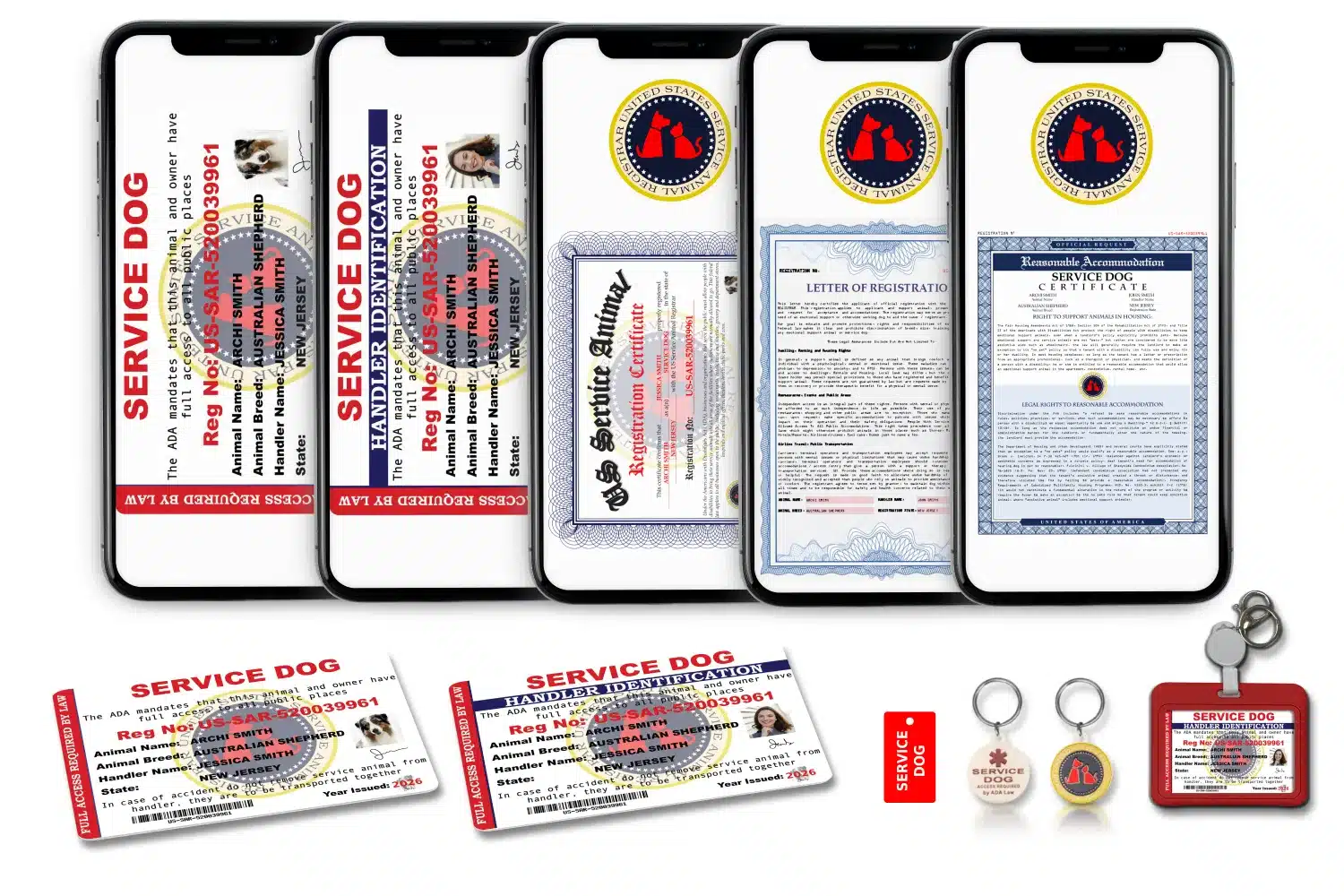
Interrupts a panic attack. Grounds you during a flashback. Wakes you from the same nightmare that's been following you for years. Blocks space in a crowd when the walls start closing in. The tasks are real, they're trained, and under 28 CFR §36.104 they make your dog a service dog — full stop, same rights as any mobility or alert dog. What we handle is the portable documentation around that work: ID cards, a registration certificate, a DOT airline form, a housing letter, and wallet passes. No clinician letter required to register. The work itself is what counts.
We don't diagnose. Your clinician does. We don't certify training. You and your dog do that.
Under 28 CFR §36.104 a psychiatric service dog is "a dog that is individually trained to do work or perform tasks for the benefit of an individual with a disability." The disability piece lives between you and your clinician; the task-training lives between you, your dog, and (if you want one) a professional trainer. Both pieces exist independently of any registry — nothing we sell creates rights under the ADA. What we do is handle the documentation around that work: ID cards with your photo and reg number, a certificate, a DOT airline form, a housing letter, and cryptographically-signed wallet passes. Neither piece replaces the other.
The moments that bring handlers here
You're not imagining it. These are the four most common reasons someone decides it's time to register their psychiatric service dog.
The panic hits in public
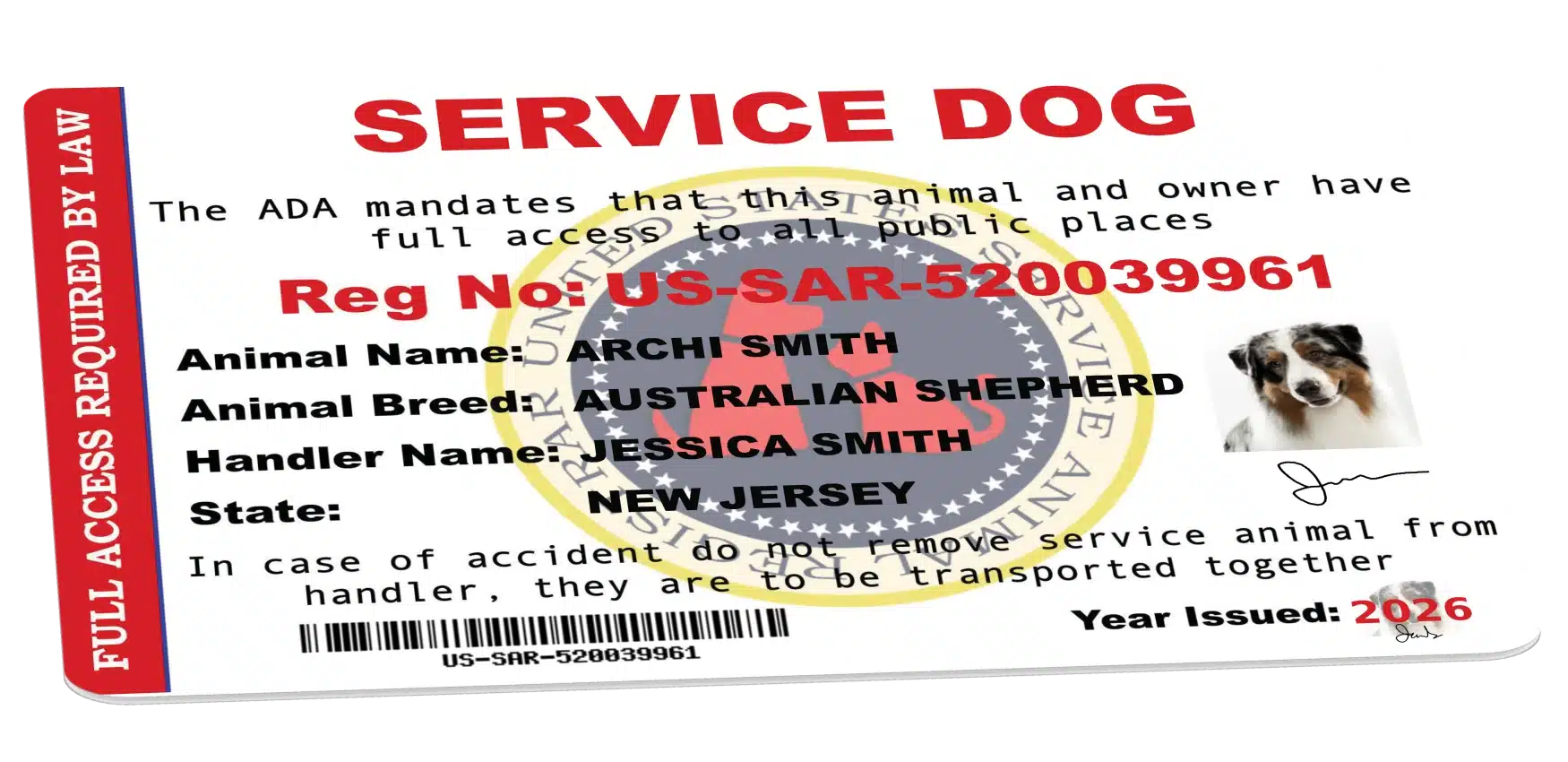
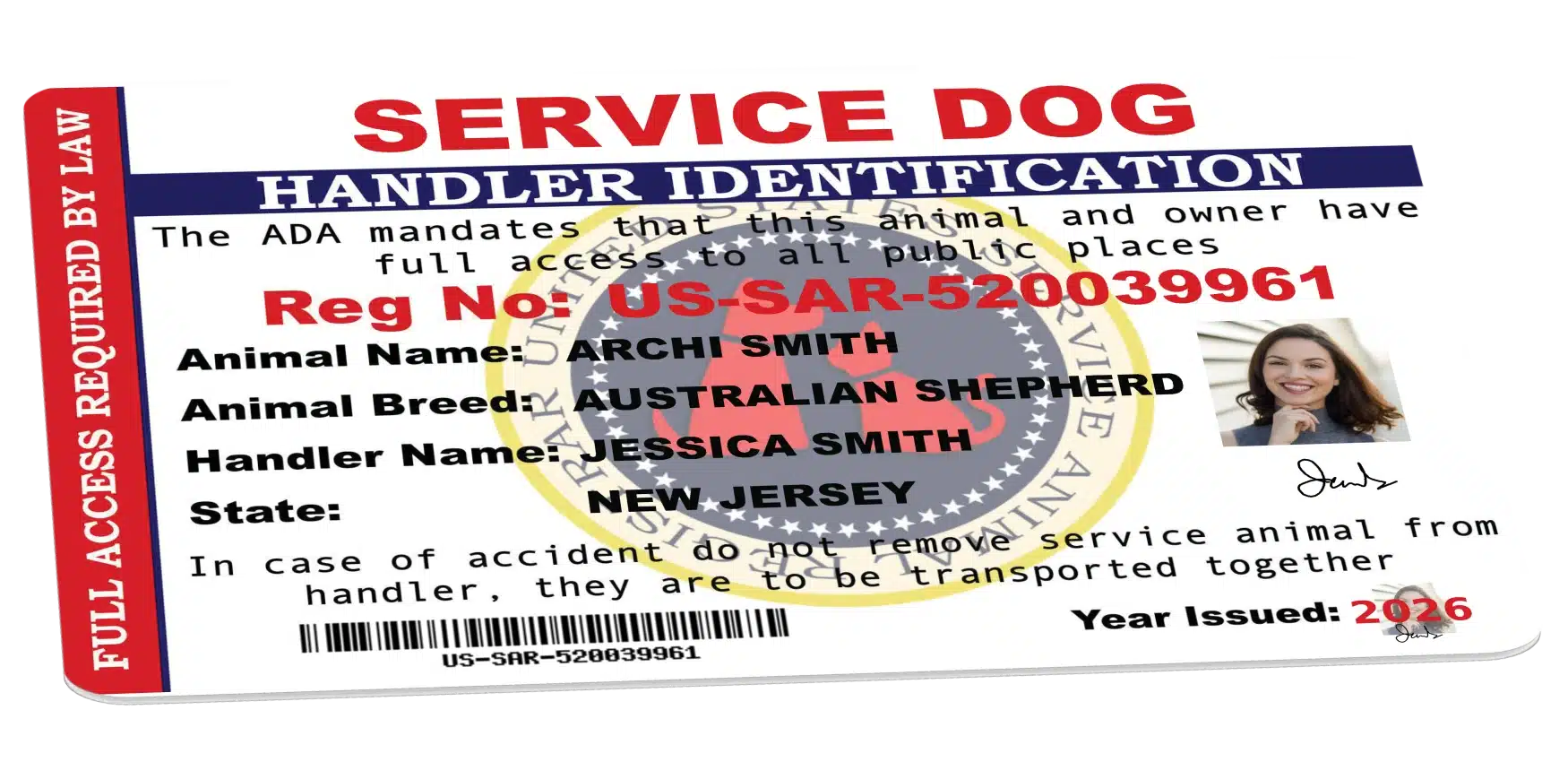
You're at the grocery store and suddenly your heart is racing. Your breathing gets shallow. Your dog is already pressed against your leg, blocking everyone else out, grounding you. The manager walks over. A laminated ID, your reg number, a four-second handoff — and you get to stay focused on the work your dog is already doing.
3am nightmare wake-up — and the housing letter
You sleep better because your dog wakes you mid-nightmare. But the landlord still wants proof the dog isn't a pet. An FHA-aligned housing letter + your registration packet is the paperwork that ends the pet-deposit conversation before it starts. You spend your energy on recovery, not arguing.
Flying — the DOT form for PSDs
Under 14 CFR Part 382, airlines can require a Service Animal Air Transportation Form before boarding. Psychiatric service dogs qualify; we generate the form pre-filled as part of every PSD package. Present it at the gate, skip the twenty-minute explanation of what your dog does.
The invisible-disability problem
Nobody can see PTSD. Nobody can see agoraphobia. People look at you, look at your dog, and decide you "don't look disabled enough." The card in your hand doesn't explain your diagnosis — it doesn't have to. It shows your reg number, your dog's status, and ends the conversation fast.
Trained, disability-related tasks — not comfort
Under federal law, the line between a psychiatric service dog and an emotional support animal is trained tasks. These are the six we see most often. If your dog does even one of these in response to your disability symptoms, that's task-based work — and under 28 CFR §36.104 it makes them a service dog.
Interrupts panic attacks
Recognizes the physical onset of a panic episode and intervenes — deep pressure, blocking, or grounding — before the spiral takes hold.
Grounds you during flashbacks
Brings you back to the present when a trauma memory pulls you out — through pressure, repetitive behavior, or a learned signal you've built together.
Creates space in crowds
Positions between you and the nearest person — a trained "block" or "cover" cue — when a crowd gets too close and hypervigilance kicks in.
Wakes you from nightmares
Senses REM-phase distress and breaks the cycle with a nudge, lick, or paw-touch trained to interrupt night terrors and PTSD dreams.
Medication reminders
On a schedule or a timer, your dog learns to alert you — one less thing to hold alone when executive function is already compromised.
Deep pressure therapy (DPT)
On cue, your dog lies across your chest or lap. DPT triggers the parasympathetic nervous system — a trained physiological intervention, not comfort.
From explaining yourself to handing over a folder
The ADA is on your side whether you register or not. What registration changes is the conversation — five seconds with a laminated ID versus fifteen minutes of justifying an invisible disability.
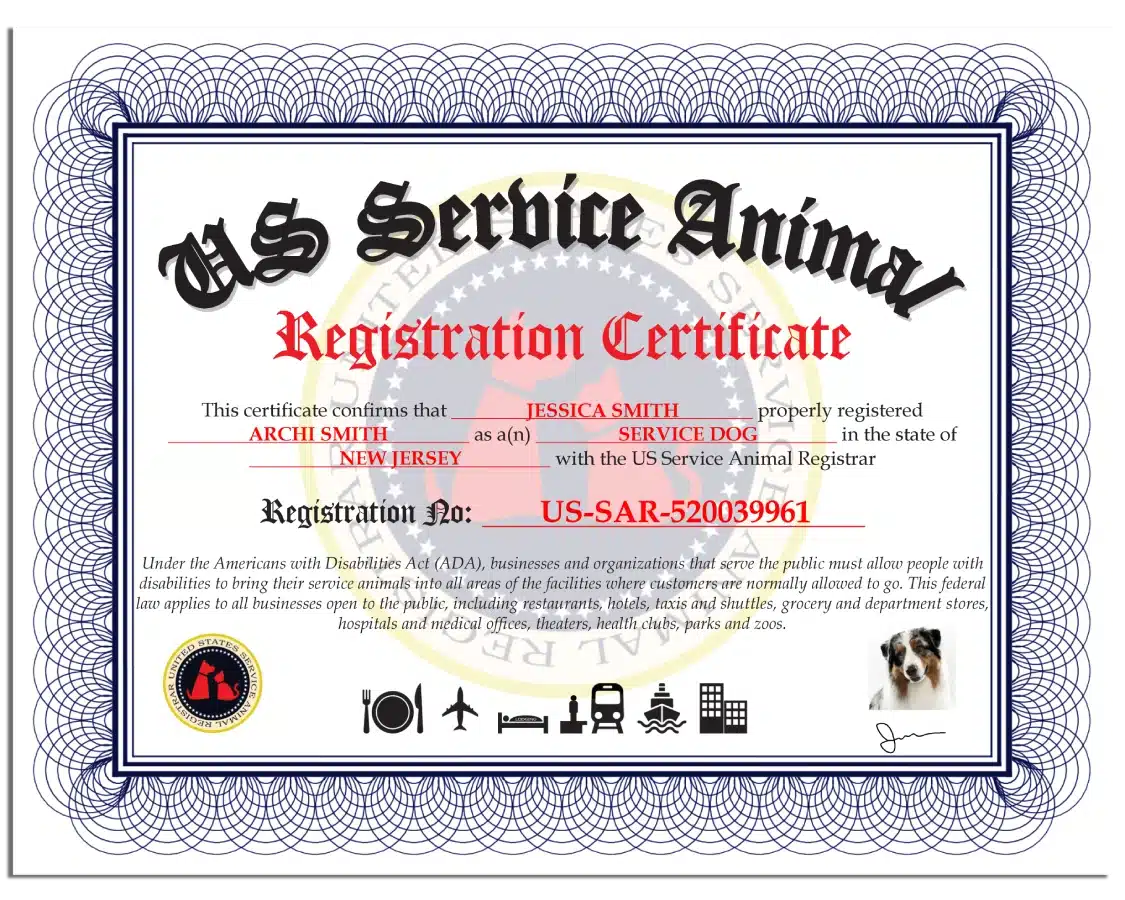
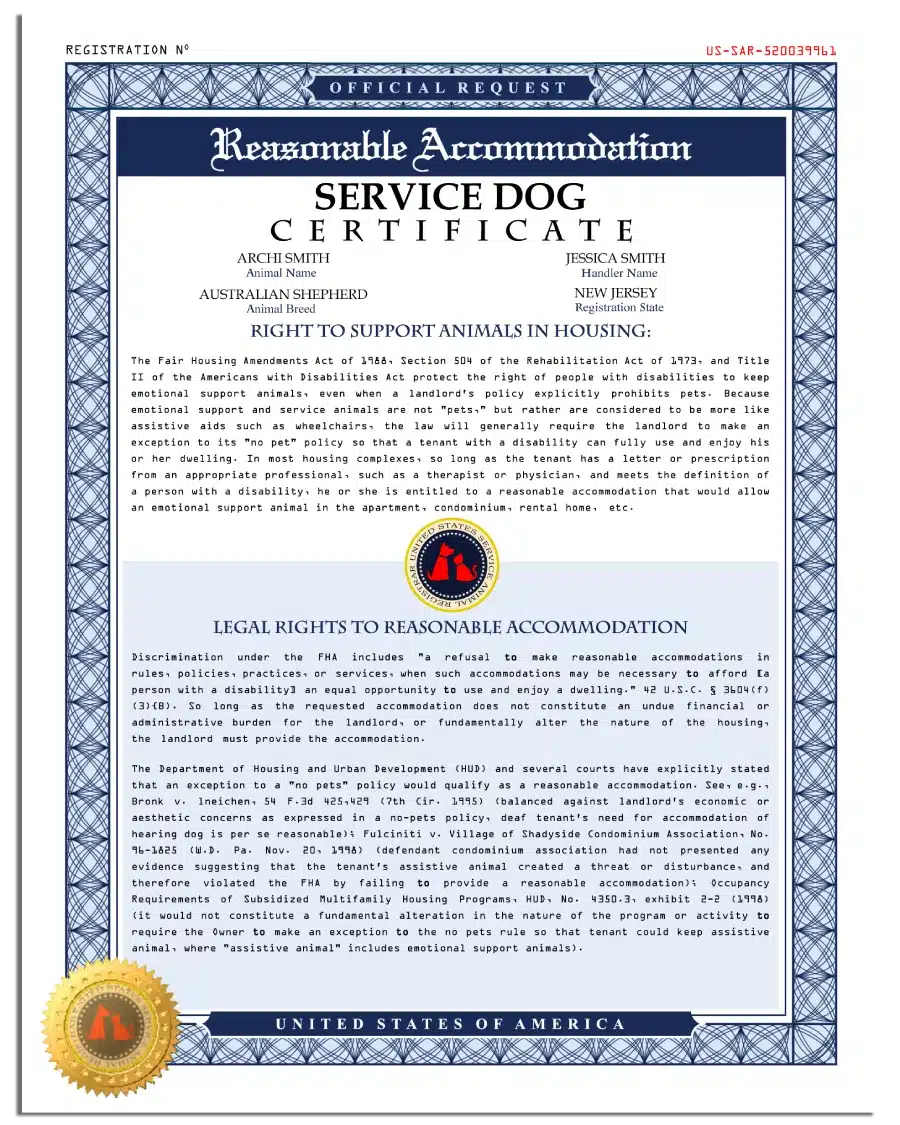
Before
After
The legal line is trained tasks
Both are legitimate. Both are protected. They're protected differently, and the difference matters for what documentation is honest to buy.
Psychiatric Service Dog
- Performs specific, trained tasks in response to a psychiatric disability
- Covered by the ADA — public access to restaurants, stores, workplaces, hospitals
- Covered by the FHA — no pet deposit, no breed ban, no "no pets" policy applies
- Covered by the DOT — airlines may require the Service Animal Air Transportation Form
- Business staff may ask only the two ADA questions (not your diagnosis)
- Registered as: Psychiatric Service Dog (counts as SD for pricing)
Emotional Support Animal
- Provides therapeutic support through presence — no specific trained tasks
- Not covered by the ADA — businesses may lawfully refuse entry
- Covered by the FHA — housing accommodation with a valid clinician letter
- Airlines no longer required to accept ESAs in-cabin (as of 2021 DOT rule)
- Landlord may require documentation; the FHA accommodation letter is what they need
- Registered as: Emotional Support Animal — see ESA page
Real handlers. Real shifts in how the day goes.
In handlers' own words. Names shortened for privacy.
For years I thought I was just broken. When my dog was officially registered as a psychiatric service dog, something shifted in how I carried it. I wasn't broken — I was disabled, my dog was doing real work, and I had paperwork that matched what my clinician had been telling me for years. My landlord stopped asking questions. My family took me more seriously. I felt like I finally had proof of what I'd known all along.
My landlord wanted a $500 pet deposit and monthly pet rent. I handed over the FHA housing letter, my registration packet, and a short note from my therapist. They pulled both charges the next day. I didn't have to threaten a HUD complaint or get a lawyer involved — the packet just made the answer obvious. That's what I was paying for, and it worked.
Flying used to be impossible. My dog helps me get on planes. The DOT form alone was worth the registration — I pulled it up in my wallet pass at the gate and the agent checked the boxes and waved us through. No phone calls to the airline, no surprise denials, no standing at the counter trying to explain agoraphobia to a stranger. I've flown home to see my family twice since.
What the ADA actually says — and why PSDs are service dogs
This is the plain-English version. For the full legal walkthrough, see our ADA Resources page, which cites the statute and current DOJ guidance.
A service dog is defined by trained tasks — psychiatric tasks count
Under 28 CFR §36.104, a service animal is "a dog that is individually trained to do work or perform tasks for the benefit of an individual with a disability." A psychiatric disability is a disability under the ADA. Tasks like interrupting panic, grounding during flashbacks, or deep pressure therapy are tasks under the regulation. That's why PSDs get full service-dog rights — same statute, same protections.
Public access is protected in almost every public place
28 CFR §36.302 covers service dogs in restaurants, hotels, shops, grocery stores, airports, stadiums, hospitals, houses of worship, rideshares, public transit, and anywhere the public is invited. Pet-free policies generally do not apply to a trained service dog — including psychiatric service dogs.
Staff may ask only two questions
Business staff can ask (1) is this a service dog required because of a disability, and (2) what work or tasks has the dog been trained to perform. They cannot ask about your diagnosis, demand paperwork, ask for a demonstration of the task, or charge you a pet fee. For PSD handlers this matters — nobody gets to interrogate you about your mental health to seat you at a table.
- Is the dog a service animal required because of a disability?
- What work or task has the dog been trained to perform?
Housing is covered under the FHA (with or without ADA access)
PSDs get full Fair Housing Act coverage — no pet deposit, no breed ban, no "no pets" policy applies. Your landlord may request reasonable documentation of the disability-related need; they may not require a specific diagnosis or training certificate. A clinician's accommodation letter plus your registration packet is the usual combination. See Housing Rights for the full FHA walkthrough.
Flying is handled under the DOT, not the ADA
Air travel runs under the Department of Transportation's Air Carrier Access Act (14 CFR Part 382). Airlines may require a pre-filled Service Animal Air Transportation Form before boarding — and PSDs qualify alongside other service dogs. Every SD and PSD package generates that form for you. See the Flying guide for gate-agent scripts.
Handlers have responsibilities too
The dog must be under the handler's control (leash, harness, tether, or verbal cues). The dog must be house-trained. A business may ask a PSD to leave only if it's out of control, not house-trained, or a genuine direct threat — not because staff is uncomfortable with a psychiatric disability.
What you get in the PSD packet
Registration certificate, handler + animal ID cards, DOT airline form, FHA housing letter, Letter of Registration, QR-code verification, and (with a Basic or Pro monthly add-on) Apple & Google Wallet passes that update silently when your status changes.
One tap — especially when your hands are shaking
When anxiety spikes and a stranger is asking what your dog is for, the last thing you need is to dig through a bag. We're the only PSD registry we know of that delivers handler and animal IDs directly into Apple Wallet and Google Wallet. One tap — your reg number, your photo, your status, the two ADA questions already answered on the back of the pass.
- One tap to show proof at a restaurant, gate, or leasing office
- Cryptographically signed — not screenshots, not PDFs
- Travels with you on any move; same record, same QR code
- Updates push silently when your status, photo, or details change
Pick what matches how much paperwork you'll hand over
PSD pricing matches SD pricing because under federal law PSDs are service dogs — same tier, same protections, same paperwork. Every tier includes an official registration record, the DOT Service Animal Air Transportation Form, and the public verify page link. Premium and Elite also include the FHA housing letter.
Build Your Own
- Digital Animal ID ($29.99)
- Annual registration record ($29.99)
- Add handler ID, printed cards, tags, harness, DOT form à la carte
- Public verify page
- Printed gear not included at minimum
Essential
- Digital Handler ID
- Digital Animal ID
- Digital Registration Certificate
- Digital DOT Airline Form
- Public verify page + QR
- No printed cards or gear
Classic
- Everything in Essential
- Printed Handler ID card
- Printed Animal ID card
- Printed Registration Certificate
- Printed DOT Airline Form
- Metal scannable tag (set of 3)
- No harness / collar / leash
Premium
- Everything in Classic
- Lifetime registration — no renewals ever
- Reflective Service Dog harness (sized)
- DOT Air Transportation Form (printed + digital)
- Badge holder + reel clip
- Luggage tag
- Housing Letter + Letter of Registration
Elite
- Everything in Premium
- Lifetime registration
- Reflective collar (sized)
- Red Service Dog leash
- Plastic harness tags (set of 3)
- Priority fulfillment queue
- DOT form + travel packet
Need the full side-by-side? Compare every tier on the Packages page →